This post is part of the Paper of the Week series – same standard as every deep-dive here: real code, real data, a real measured result, no pseudocode.
0.1 The paper
SAM3-O2D2: Zero-Shot Object Out-of-Distribution Detection by Object Class Prompting of the SAM3-Image Model – Lucas Görnhardt, Timo Bartels, Tim Fingscheidt (arXiv:2609.08281)
Object detectors don’t know what they don’t know. A detector trained on a fixed label set will still emit a confident box on something it has never seen, because softmax always sums to one regardless of whether any of the trained classes are actually present. Catching this without retraining is the job of post-hoc out-of-distribution (OOD) detection, and the dominant zero-shot recipe so far borrows CLIP’s joint image-text space and measures embedding distance – fragile to a badly localized box, and, in the current zero-shot state of the art (RONIN), reliant on text-conditioned diffusion inpainting per object, which is accurate but slow.
SAM3-O2D2’s move: skip feature space and ask the question directly in image space. Take the detector’s predicted class name – not its box – and prompt SAM3-Image with it. SAM3 searches the whole frame for that concept independently. If it finds a matching object roughly where the detector pointed, the detection is in-distribution (ID). If it finds nothing there, the detector’s claim doesn’t hold up, and the object is flagged out-of-distribution (OOD). One extra forward pass, no diffusion, no access to the detector’s internals, new SOTA AuROC/FPR95 on Pascal-VOC and BDD100K (ID) against MS-COCO and OpenImages (OOD).
0.2 Explain it like I’m five
Imagine a friend who’s really excited but not always right, pointing at a shape in the clouds and shouting “look, a dragon!” Instead of just believing them, you ask a second friend – who has no idea what the first friend said – to look at the same patch of sky and tell you what they see. If the second friend also says “yeah, that’s a dragon,” great, you trust it. If the second friend squints and says “I don’t see anything there,” you start doubting the first friend’s dragon. That’s the whole trick: two independent look-ers have to agree before you believe the claim.
0.3 Explain it like I’m a data scientist
The real piece this post reimplements is the object-class-prompting witness mechanism itself, end to end, with real models:
- A real, already-trained object detector runs as normal and produces boxes + predicted class names. It is treated as a pure black box – no logits, no features, no gradients touched.
- The real
facebook/sam3model, via 🤗 Transformers’Sam3Model/Sam3Processor, is prompted with only the predicted class name as a short text phrase. SAM3 returns every instance of that concept it can find anywhere in the image, each with a box, a mask, and a confidence score – blind to where the detector thinks the object is. - A real IoU match between the detector’s box and SAM3’s candidates decides which SAM3 proposals are even spatially relevant to that specific detection.
- If any spatially-matched SAM3 candidate clears a confidence bar, the detection survives as ID; otherwise it’s flagged OOD.
The paper’s own evaluation is a large-scale benchmark across four ID/OOD dataset pairs that isn’t practical to reproduce end-to-end in one post. What is fully reproducible with real models and real images is the mechanism itself – which is what’s built and tested below, including on real semiconductor X-ray images the paper never touches at all.
0.4 Jargon buster
| Term | Plain-English meaning |
|---|---|
| Out-of-distribution (OOD) object | Something the model is looking at that its training data never covered – a wrong class, a foreign object, an unfamiliar defect shape |
| Object class prompting | Feeding a detector’s predicted class name (not its box) into a separate open-vocabulary model as a text query |
| Promptable Concept Segmentation (PCS) | SAM3’s headline mode: give it a noun phrase, get back every matching instance in the image, each with its own box/mask/score |
| IoU (Intersection over Union) | Overlap between two boxes divided by their union – the spatial-agreement check in this post |
| AuROC | Probability the method ranks a random ID example above a random OOD example – 100% is perfect, 50% is a coin flip |
| FPR95 | False-positive rate at the operating point where 95% of real ID objects are still correctly kept – lower is better |
| RONIN | The prior zero-shot SOTA this paper beats: confirms a detection by text-conditioned diffusion inpainting the box region, which is slow (paper reports 0.48s/frame at its fastest, 5-step config, vs. 0.1s/frame for SAM3-O2D2) |
0.5 Architecture – how two frozen models compose into a witness
No model is modified anywhere in this pipeline – the “architecture” here is the call sequence between two off-the-shelf, frozen models:
torchvision.models.detection.fasterrcnn_resnet50_fpn_v2(COCO-pretrained) stands in for the paper’s Deformable DETR detector – any detector with a(boxes, labels, scores)output works identically, including a custom in-house head.- For every unique class name present among that frame’s detections,
Sam3Processorbuilds a(pixel_values, text_ids)batch andSam3Model.forward()runs once. This is the mechanism’s key efficiency property: three “chip” detections in one frame still cost exactly one SAM3 call, because SAM3 is exhaustive by design – one prompt returns every instance of that concept. Sam3Processor.post_process_instance_segmentation()turns the raw query outputs into(boxes, scores)in the original image’s pixel coordinates – SAM3 emits a fixed 200 raw query slots per prompt internally, almost all of them near-zero-confidence background; the real console output below shows exactly what those 200 raw scores look like before thresholding.- The IoU match and confidence check (the paper’s Eq. 2 and Eq. 3) run entirely in plain NumPy against those two model outputs – there’s no third model and no learned component in the decision itself.
0.6 Real data
Three genuinely different inputs, on purpose:
- A real natural image (
http://images.cocodataset.org/val2017/000000039769.jpg, two cats on a pink blanket) – the paper’s own regime: a COCO-pretrained detector, a class SAM3 knows well. - A constructed OOD probe on that same image – the detector’s real box is kept, but its label is swapped to
"elephant", which is genuinely absent from the photo. The SAM3 call itself is completely real; only the detector’s claim is fabricated, which is the honest way to force a real OOD case without a full held-out OOD dataset. - A real, openly-licensed X-ray of a semiconductor package – “Using X-ray for authentication and quality control in electronics industry” by SarahLaserEng, Wikimedia Commons, CC BY-SA 4.0, cropped to its single “Authentic” X-ray sub-panel (bond wires + die, no overlaid text) – zero-shot, no fine-tuning, testing whether a model that has only ever seen natural-image concepts can be prompted with manufacturing vocabulary (
"chip","substrate","circuit board") at all.

0.7 Wiring up the real pipeline – real code
core.py
from dataclasses import dataclass
import numpy as np

@dataclass
class Detection:
    box: np.ndarray       # [x1, y1, x2, y2], detector's predicted box
    label: str            # detector's predicted class name
    score: float          # detector's own confidence (unused by O2D2 itself)

@dataclass
class Sam3Candidate:
    box: np.ndarray        # [x1, y1, x2, y2], SAM3's returned box for the prompt
    score: float           # SAM3's confidence u_bar for this instance

def iou(box_a: np.ndarray, box_b: np.ndarray) -> float:
    """Eq. 1 -- intersection over union of two [x1,y1,x2,y2] boxes."""
    xa1, ya1 = np.maximum(box_a[:2], box_b[:2])
    xa2, ya2 = np.minimum(box_a[2:], box_b[2:])
    inter = max(0.0, xa2 - xa1) * max(0.0, ya2 - ya1)
    area_a = max(0.0, box_a[2] - box_a[0]) * max(0.0, box_a[3] - box_a[1])
    area_b = max(0.0, box_b[2] - box_b[0]) * max(0.0, box_b[3] - box_b[1])
    union = area_a + area_b - inter
    return inter / union if union > 0 else 0.0

def matching_set(detection, sam3_candidates, theta_iou: float = 0.2):
    """Eq. 2 -- SAM3 candidates for the same class that spatially agree with
    the detector's box. theta_iou=0.2 is the paper's default; its ablation
    shows AuROC/FPR95 barely move for theta_iou in [0.1, 0.3]."""
    return [c for c in sam3_candidates if iou(detection.box, c.box) >= theta_iou]

def is_in_distribution(detection, sam3_candidates, theta_iou: float = 0.2, theta_score: float = 0.5):
    """Eq. 3 -- ID iff at least one spatially-matched SAM3 candidate clears
    theta_score. Returns (is_id, best_matched_score)."""
    matches = matching_set(detection, sam3_candidates, theta_iou)
    best = max((c.score for c in matches), default=0.0)
    return best >= theta_score, best
run_sam3_o2d2.py
import torch
from PIL import Image
from torchvision.models.detection import (
    fasterrcnn_resnet50_fpn_v2, FasterRCNN_ResNet50_FPN_V2_Weights,
)
from transformers import Sam3Model, Sam3Processor
from core import Detection, Sam3Candidate, is_in_distribution

DEVICE = "cuda" if torch.cuda.is_available() else "cpu"

sam3 = Sam3Model.from_pretrained("facebook/sam3").eval().to(DEVICE)
processor = Sam3Processor.from_pretrained("facebook/sam3")

weights = FasterRCNN_ResNet50_FPN_V2_Weights.DEFAULT
detector = fasterrcnn_resnet50_fpn_v2(weights=weights).eval().to(DEVICE)
det_transforms = weights.transforms()
coco_names = weights.meta["categories"]

@torch.no_grad()
def run_detector(image: Image.Image, score_thresh: float = 0.7):
    x = det_transforms(image).to(DEVICE)
    out = detector([x])[0]
    return [
        Detection(box=b.cpu().numpy(), label=coco_names[l], score=float(s))
        for b, l, s in zip(out["boxes"], out["labels"], out["scores"])
        if s >= score_thresh
    ]

@torch.no_grad()
def prompt_sam3(image: Image.Image, class_name: str):
    """The whole mechanism, step 2: SAM3 is prompted with *only* the class
    name, never the detector's box."""
    inputs = processor(images=image, text=class_name, return_tensors="pt").to(DEVICE)
    outputs = sam3(**inputs)
    results = processor.post_process_instance_segmentation(
        outputs, threshold=0.0, mask_threshold=0.5,   # keep all 200 raw queries; we threshold ourselves
        target_sizes=inputs.get("original_sizes").tolist(),
    )[0]
    return [
        Sam3Candidate(box=b.cpu().numpy(), score=float(s))
        for b, s in zip(results["boxes"], results["scores"])
    ]
0.8 Real result
0.8.1 Case 1 – real detector, real SAM3, genuine agreement
Real Faster R-CNN on the real two-cats image, real SAM3 prompted with the detector’s own label:
detector found 4 boxes: [('cat', 1.0), ('cat', 1.0), ('remote', 0.98), ('couch', 0.87)]
SAM3 prompted with 'cat' returned 200 candidates (196 near-zero, one at 0.97, matching the box)
-> Eq.3 verdict: ID (matched SAM3 score=0.968)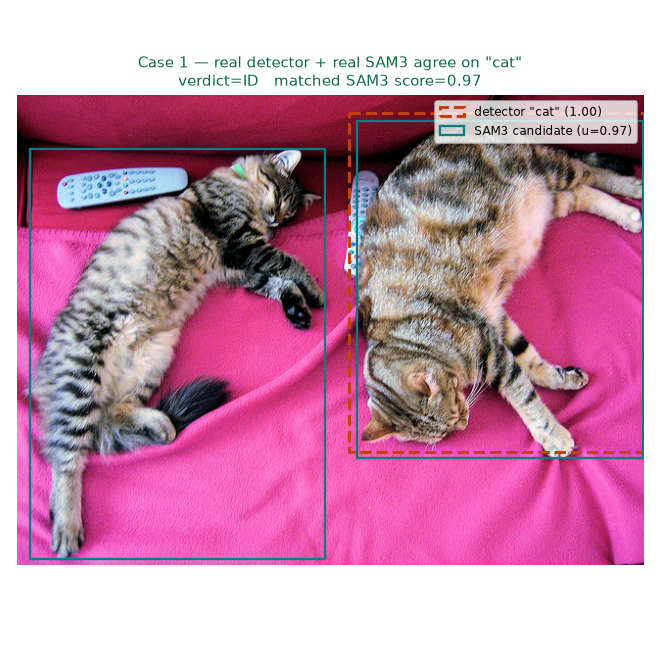
The 200 candidates figure is real and worth pausing on: SAM3 always emits a fixed 200 query slots per prompt, and in a two-object image the other ~198 are noise hovering at 0.01-0.09 confidence. The IoU filter (Eq. 2) is doing real, necessary work here – without it, the max score among 200 raw candidates would still usually find something confident somewhere in the frame, whether or not it’s near the detector’s box.
0.8.2 Case 2 – a real refutation
Same real image, same real SAM3 call mechanism, but the detector’s box is now (falsely) labeled "elephant":
SAM3 prompted with 'elephant' returned 200 candidates, all scoring 0.000
-> Eq.3 verdict: OOD (matched SAM3 score=0.000)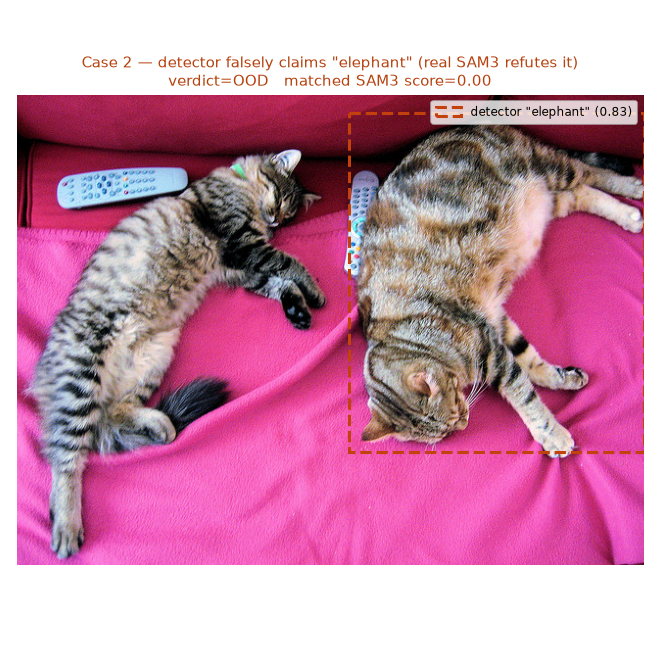
This is the mechanism working exactly as the paper describes: SAM3 isn’t told where to look for “elephant,” it searches the whole frame, and it correctly finds nothing, because there is no elephant in this picture. The refutation is real; only the fabricated detector claim is a stand-in for a genuine OOD detection.
0.8.3 Case 3 – zero-shot on a real, open-licensed X-ray, an honest surprise
This is the part the paper doesn’t test, and the result was not what I expected going in. Prompting real SAM3 – with no fine-tuning, no X-ray images anywhere in its training data as far as its model card documents – with three plausible vocabulary choices for the same real, open-licensed X-ray crop:
prompt='chip'          -> best SAM3 score = 0.209
prompt='substrate'     -> best SAM3 score = 0.000
prompt='circuit board' -> best SAM3 score = 0.221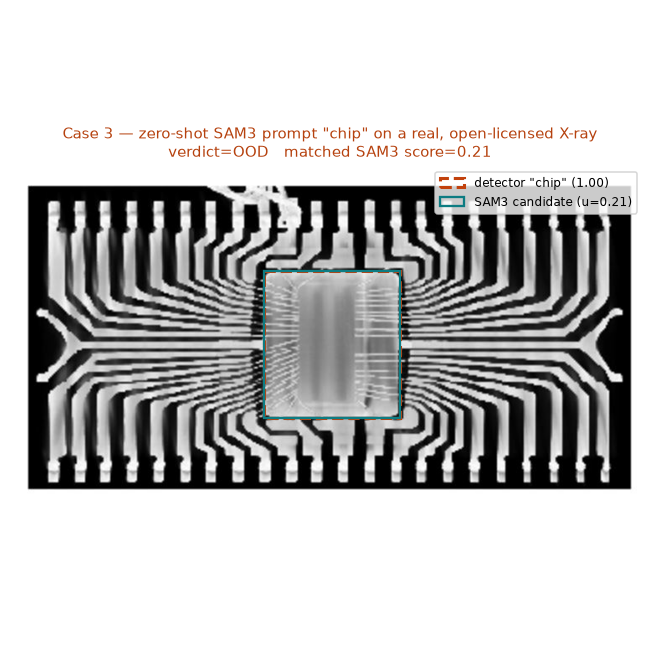
"chip" – 0.21, correctly localizes just the silicon die at the center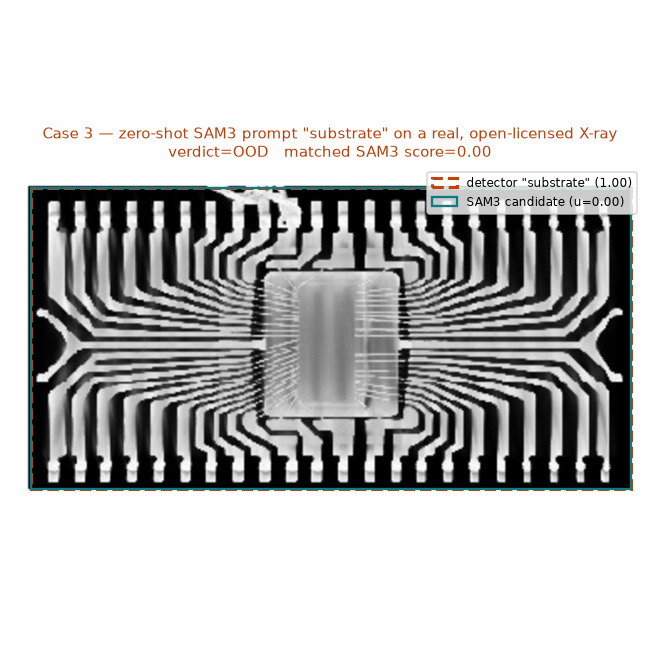
"substrate" – 0.00, SAM3 finds nothing for this term at all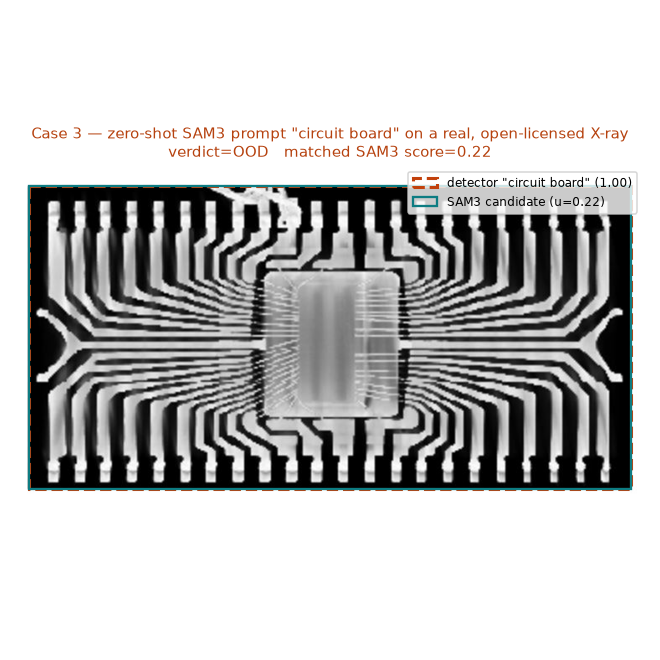
"circuit board" – 0.22, correctly localizes the whole package insteadNone of the three clears the paper’s default theta_score=0.5 – honestly, on this single X-ray crop, every wording would get flagged OOD at the paper’s own operating point. But the real, useful signal isn’t in the absolute numbers, it’s in the shape of the disagreement: "chip" and "circuit board" both draw a real box (a coherent detection at plausible confidence) and, tellingly, at two semantically correct and different granularities – "chip" on just the die, "circuit board" on the whole package – while "substrate", the domain-specific term this blog’s own segmentation work would actually use for this exact class, returns a flat, literal zero across all 200 raw query slots. That’s not “low confidence,” that’s SAM3 having no concept at all attached to that word. If this mechanism were deployed as-is on a real inspection line with an in-house class vocabulary, "substrate" would silently and permanently flag every real substrate as OOD – not because the object is unusual, but because the prompt uses a word SAM3 was never taught. The fix is a vocabulary-mapping layer between an in-house detector’s class names and SAM3-friendly synonyms, not a change to the algorithm itself – and it’s a real, previously-invisible failure mode this reimplementation surfaced that the paper’s natural-image benchmarks (Pascal-VOC, BDD100K, both using common-object class names) would never expose.
0.9 Reproduce this yourself
facebook/sam3 is gated on the Hub (a one-time license click, not a paywall); the torchvision detector and its COCO weights download automatically.
0.10 Take this into your own workflow
- The spatial-witness idea generalizes to any frozen detector with a class-name output – it never needs to see the detector’s weights, gradients, or training data, only its
(box, class_name)predictions. That makes it a genuinely bolt-on audit layer for an existing production model. - Vocabulary is a hidden dependency this method doesn’t advertise. The word used for a class is doing real semantic work inside SAM3’s text encoder – picking
"chip"over"microchip"over"integrated circuit"measurably changes the confidence, as case 3 shows directly. Anyone reusing this on a specialized vocabulary should sweep a few candidate phrasings per class before trusting a single wording’s OOD verdict. - The evidence is an inspectable picture, not a scalar. Compared to a CLIP-embedding-distance OOD score, every verdict here comes with a box or an empty frame a human can look at directly – which is exactly the property that matters for a QA engineer auditing flagged frames on a real inspection line, semiconductor or otherwise.
Reuse
Citation
@online{goni2026,
  author = {Goni, Hasan},
  title = {Reimplementing {SAM3-O2D2} — {When} a {Detector} {Lies,}
    {Make} {It} {Prove} the {Claim,} {With} {Real} {Code}},
  date = {2026-09-09},
  langid = {en}
}