---
title: "Mask-Conditioned Diffusion Fine-Tuning"
description: "Part 1 got the physics right by calibration. This post asks the mirror-image question: what if a model just learned real defect texture from data instead?"
search: false
author: "Hasan Goni"
date: last-modified
categories: [computer-vision, synthetic-data, X-ray, diffusion, LoRA]
image: images/synth-xray-diffusion-eli5-sketch.png
toc: true
series:
name: "Synthetic Data Series"
number: 2
format:
html:
code-fold: true
code-tools: true
---
::: {.callout-note}
**Images removed.** This post's figures showed frames from [GDXray](https://domingomery.ing.uc.cl/material/gdxray) or outputs of models trained on them. GDXray is free for research and education only, and redistribution is not allowed, so the figures are gone. The text, code, numbers and plots are unchanged. The new [synthetic void dataset](../agentic-factory-segmentation/01-synthetic-void-dataset.qmd) is what this blog shows from now on.
:::
:::{.callout-tip}
This post is part of the [Synthetic Data Series](index.qmd) series.
:::
## The problem
[Part 1](01-physics-based-xray-simulation.qmd) inverted the Beer-Lambert law on a real X-ray
image, edited a hand-drawn crack shape into the resulting thickness map, and re-rendered it --
getting the sensor noise and attenuation statistics right *by calibration*, because the physics
model is explicit about what those statistics should be. What it can't do is make the defect
itself look like anything other than a random-walk shape with plausible contrast: there's no
learned notion of what a *real* crack's branching, texture, or micro-structure looks like, because
nothing in that pipeline has ever seen one.
This post asks the mirror-image question. Instead of modeling the physics and drawing the defect
by hand, what if a generative model just learned the defect *texture* directly from real examples?
Stable Diffusion's inpainting variant is built for exactly this shape of problem -- given an image
and a mask, generate plausible content for the masked region, conditioned on everything outside
it. Fine-tune it on real GDXray weld defects specifically, and see whether it does better than
physics at the one thing physics has no data-driven opinion about: what a defect actually looks
like.
## Explain it like I'm five
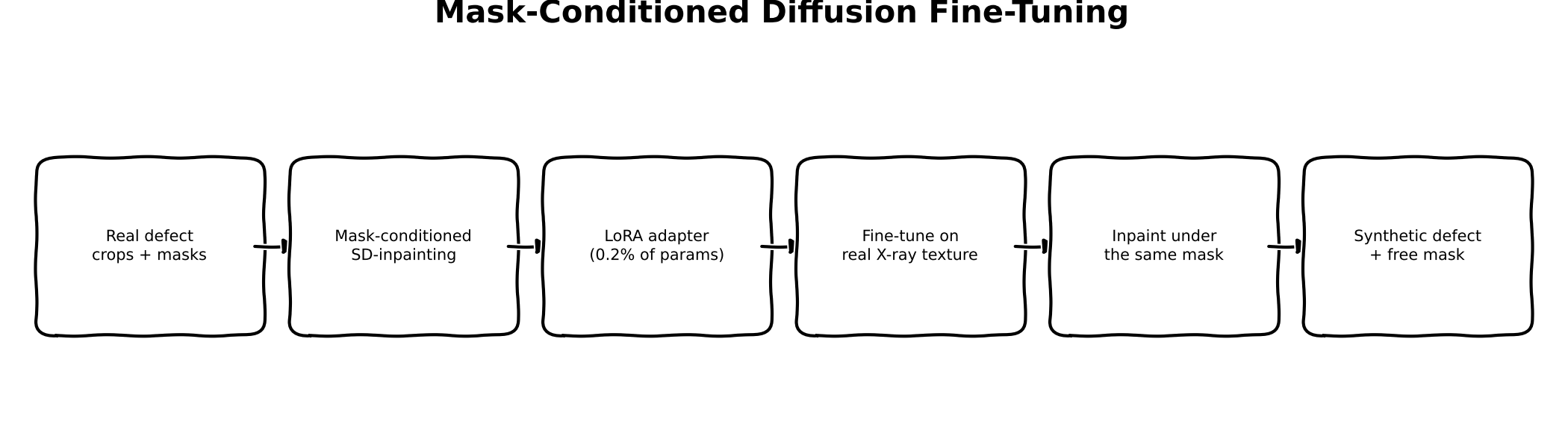
Imagine an artist who's really good at filling in torn-out pieces of any photograph -- give them a
photo with a hole cut in it, and they'll paint something plausible into the hole that matches the
surrounding picture. That's what a mask-conditioned inpainting model already does, out of the box,
for *any* kind of photo.
Now imagine you want that artist to fill in holes with a very specific kind of scribble: real
X-ray weld defects, which they've never actually seen before -- they've only ever practiced on
everyday photos. So you show them a stack of real X-ray images with real defects circled, over and
over, and let them adjust just a *tiny* part of their technique (not retrain from scratch -- that
would take forever and erase everything else they already know how to draw). After a while, when
you cut a hole in a new X-ray image and ask them to fill it in, they lean a little more toward
"weld defect" and a little less toward "generic photo texture." The mask tells them exactly where
to draw; the practice changes what they draw there.
## Explain it like I'm a data scientist
A standard denoising diffusion model learns to reverse a fixed noising process: take a real image
$x_0$, add Gaussian noise over $T$ steps to get $x_t$, and train a network $\epsilon_\theta$ to
predict the noise $\epsilon$ that was added, given $x_t$ and the timestep $t$:
$$\mathcal{L} = \mathbb{E}_{x_0, \epsilon, t} \left[ \| \epsilon - \epsilon_\theta(x_t, t) \|^2 \right]$$
`stable-diffusion-v1-5/stable-diffusion-inpainting` is the same objective with one architectural
change: $\epsilon_\theta$'s UNet takes 9 input channels instead of 4 -- the usual 4-channel noisy
latent, plus a 1-channel downsampled mask, plus the 4-channel latent of the *masked* image (the
real image with the mask region blacked out before encoding). The mask and masked-image channels
are the model's only view of "what's actually there" outside the hole; conditioning on them at
every denoising step is what makes the output respect the unmasked context instead of
hallucinating a new image from scratch.
Fine-tuning a 981M-parameter pipeline (UNet + VAE + text encoder) on 338 real examples end-to-end
would overfit badly and cost far more compute than this demo needs. LoRA sidesteps both problems:
freeze every original weight, and for each targeted linear layer $W$, add a trainable low-rank
update $BA$ (rank $r{=}8$ here) so the effective weight becomes $W + BA$. Only $A$ and $B$ train;
$W$ never moves. Targeting just the UNet's attention projection layers
(`to_q`/`to_k`/`to_v`/`to_out.0`) means **1,594,368 of 861,129,732 UNet parameters actually
train -- 0.185%.**
## Jargon buster
| Term | Plain-English meaning |
|---|---|
| Mask-conditioned inpainting | A diffusion UNet with extra input channels for a mask and a masked-image latent, so it's explicitly told what to fill in and what to leave alone |
| LoRA (Low-Rank Adaptation) | Freeze a weight matrix, add a small trainable low-rank update on top -- fine-tunes a tiny fraction of parameters instead of the whole model |
| VAE latent space | Stable Diffusion doesn't diffuse raw pixels -- an autoencoder compresses images 8x spatially first; diffusion happens in that compressed space, then decodes back to pixels |
| DDPM forward process | The "add noise" half of denoising diffusion: progressively noise a real image toward pure Gaussian noise at a randomly sampled timestep; the model predicts exactly the noise that was added |
| Classifier-free guidance | Normally a diffusion model samples with and without the prompt and extrapolates toward the prompted direction; `guidance_scale=1.0` disables this, halving inference cost |
| Attention projection layers (`to_q`/`to_k`/`to_v`/`to_out.0`) | The four linear layers inside a transformer attention block -- the standard, minimal-footprint target for LoRA on a diffusion UNet |
## Architecture -- traced from the real function calls
```{mermaid}
flowchart TB
    subgraph DATA["synth_xray.diffusion_data"]
        BD["build_defect_dataset(series_dir)\n-> 338 real (image, mask) crops\n(reuses Part 1's data.py + groundtruth.py\non the same real Welds/W0001 boxes)"]
        BD --> RGB["to_rgb_pil / to_mask_pil\n-> 512x512 RGB image, single-channel mask"]
    end

    subgraph SETUP["train_diffusion_lora.py -- setup"]
        LOAD["StableDiffusionInpaintPipeline.from_pretrained\n(stable-diffusion-v1-5/stable-diffusion-inpainting)"]
        LOAD --> FREEZE["freeze vae, text_encoder, unet"]
        FREEZE --> LORA["unet.add_adapter(LoraConfig(r=8, alpha=16,\ntarget_modules=[to_k,to_q,to_v,to_out.0]))\n-> 1.59M / 861M trainable (0.185%)"]
    end

    RGB --> LOOP

    subgraph LOOP["per training step (200 real steps)"]
        ENC["vae.encode(image), vae.encode(masked_image)\n-> latents, masked_latents (frozen VAE, no_grad)"]
        ENC --> NZ["noise_scheduler.add_noise\n(random timestep, real DDPM forward process)"]
        NZ --> CAT["cat([noisy_latents, mask_latent, masked_latents])\n-> 9-channel UNet input"]
        CAT --> UNET["unet(...).sample -> predicted noise"]
        UNET --> LOSS["MSE(predicted noise, real sampled noise)\nbackward -> optimizer.step() (LoRA params only)"]
    end

    LORA --> LOOP
    LOOP -->|"every 10 steps"| RENDER["_render_frame:\nreal pipe(...) inference call\non a fixed held-out example\n-> GIF frame"]
    LOOP -->|"200 steps done"| SAVE["lora_weights.pt\n(state_dict entries containing 'lora')"]

    subgraph COMPARE["generate_diffusion_comparison.py"]
        MASK2["generate_crack_mask(..., rng=default_rng(0))\n-- Part 1's exact same call -> identical synthetic crack mask"]
        SAVE --> LOADLORA["add_adapter + load_state_dict(lora_weights.pt)"]
        MASK2 --> INFER["pipe(prompt, image, mask_image,\nnum_inference_steps=30) -> diffusion output"]
        LOADLORA --> INFER
        INFER --> CROP["Part 1's exact same crop windows\n-> synth-xray-defect-diffusion.png / -zoom.png"]
    end
```
## Real code
### Building the real training set
```{.python filename="notebooks/synthetic-data-xray/src/synth_xray/diffusion_data.py"}
"""Real (image, mask) defect-inpainting training pairs from GDXray ground truth.

Reuses Part 1's exact data/ground-truth utilities (`data.py`, `groundtruth.py`) --
same real Welds series, same box-to-mask logic -- so Part 2's LoRA fine-tune trains
on the identical real defects Part 1's physics pipeline was calibrated against.
"""
from __future__ import annotations

import pathlib

import numpy as np
from PIL import Image

from synth_xray.data import find_groundtruth_file, find_images_in_series
from synth_xray.groundtruth import bbox_to_mask, parse_gdxray_bboxes, refine_mask_otsu

# SD-inpainting's native resolution -- cropping directly at this size avoids any
# resize step between the real pixel data and what the model actually trains on.
# These weld panoramas (e.g. 835x4919) are comfortably larger than 512 in both
# dimensions, so this never needs to upsample.
CROP_SIZE = 512
# Margin (px) a defect box must fit inside of, so the crop always has real
# non-defect context surrounding the mask, not just the defect itself.
PAD = 40


def image_id_from_path(path: pathlib.Path) -> int:
    """Map a GDXray series image filename to its ground-truth `image_id` column.

    Same convention verified in `generate_examples.py`: `<SERIES>_<NNNN>.png` -> N.
    """
    return int(path.stem.split("_")[-1])


def load_gray(path: pathlib.Path) -> np.ndarray:
    return np.array(Image.open(path).convert("L"), dtype=np.float64)


def crop_around_box(
    image: np.ndarray, box: tuple[int, int, int, int], crop_size: int = CROP_SIZE
) -> tuple[np.ndarray, tuple[int, int]]:
    """Crop a fixed-size square window centered on a defect box, clamped to image bounds."""
    row_min, col_min, row_max, col_max = box
    cy, cx = (row_min + row_max) // 2, (col_min + col_max) // 2
    half = crop_size // 2
    r0 = max(0, min(cy - half, image.shape[0] - crop_size))
    c0 = max(0, min(cx - half, image.shape[1] - crop_size))
    return image[r0 : r0 + crop_size, c0 : c0 + crop_size], (r0, c0)


def build_defect_dataset(series_dir: pathlib.Path) -> list[dict]:
    """Real (image crop, defect mask) pairs for every ground-truth box in a GDXray series.

    Each returned dict: {"image": float64 (CROP_SIZE, CROP_SIZE) grayscale array,
    "mask": bool (CROP_SIZE, CROP_SIZE) array, "image_id": int, "box": original bbox}.
    """
    gt_file = find_groundtruth_file(series_dir)
    if gt_file is None:
        return []
    boxes_by_image = parse_gdxray_bboxes(gt_file)

    examples: list[dict] = []
    for img_path in find_images_in_series(series_dir):
        image_id = image_id_from_path(img_path)
        boxes = boxes_by_image.get(image_id, [])
        if not boxes:
            continue
        image = load_gray(img_path)
        if image.shape[0] < CROP_SIZE or image.shape[1] < CROP_SIZE:
            continue  # panorama too small for a full-resolution crop

        for box in boxes:
            row_min, col_min, row_max, col_max = box
            if row_min < 0 or col_min < 0:
                # A handful of real GDXray boxes come out as -1 on one edge (the
                # raw annotation sits at the image boundary, and the 1-indexed ->
                # 0-indexed `- 1` in parse_gdxray_bboxes takes an already-0 raw
                # value to -1). A negative slice start wraps around in Python and
                # silently produces an empty (or wrong) mask rather than raising,
                # so this has to be caught explicitly rather than left to fail
                # downstream.
                continue
            if (row_max - row_min) < 2 or (col_max - col_min) < 2:
                continue  # degenerate/annotation-noise box
            if (row_max - row_min) > CROP_SIZE - 2 * PAD or (col_max - col_min) > CROP_SIZE - 2 * PAD:
                continue  # defect too large to sit inside a padded crop

            crop, (r0, c0) = crop_around_box(image, box, CROP_SIZE)
            local_box = (row_min - r0, col_min - c0, row_max - r0, col_max - c0)
            roi_mask = bbox_to_mask(crop.shape, local_box)
            if roi_mask.sum() == 0:
                continue  # box fell outside the crop window
            defect_mask = refine_mask_otsu(crop, roi_mask)
            if defect_mask.sum() < 4:
                continue  # Otsu split degenerated to almost nothing

            examples.append({"image": crop, "mask": defect_mask, "image_id": image_id, "box": box})

    return examples


def to_rgb_pil(gray: np.ndarray) -> Image.Image:
    """Grayscale float array -> 3-channel RGB PIL image (SD expects 3 input channels)."""
    normalized = np.clip(gray, 0, 255).astype(np.uint8)
    return Image.fromarray(np.stack([normalized] * 3, axis=-1))


def to_mask_pil(mask: np.ndarray) -> Image.Image:
    """Boolean mask -> single-channel 'L' PIL image (0 = keep, 255 = inpaint)."""
    return Image.fromarray((mask.astype(np.uint8) * 255))
```
Run against the real data: **338 usable (image, mask) pairs** out of 641 raw ground-truth boxes in
series W0001 -- most of the loss is the negative-coordinate edge case and the size filters above,
not a limitation of the underlying data.
### LoRA fine-tuning loop
```{.python filename="notebooks/synthetic-data-xray/train_diffusion_lora.py"}
"""Real LoRA fine-tune of a mask-conditioned Stable Diffusion inpainting model on
real GDXray weld defect crops + masks -- Synthetic Data series Part 2.

The question this answers: does a generative model that has actually seen real
X-ray defect *texture* produce better synthetic defects than Part 1's
physics-based simulation, which has no learned texture prior at all -- only a
calibrated attenuation/noise/blur model?

What's real here, not pseudocode:
- `stable-diffusion-v1-5/stable-diffusion-inpainting` is loaded as-is (public,
  non-gated) -- a real, standard mask-conditioned inpainting UNet: 9 input
  channels (4 noisy-latent + 1 mask + 4 masked-image-latent), exactly the
  scheme it was itself originally trained with.
- LoRA (`r=8, alpha=16`, targeting the UNet's `to_q/to_k/to_v/to_out.0`
  attention-projection layers) is injected via diffusers' own
  `UNet2DConditionModel.add_adapter()` -- the base UNet stays frozen; only the
  LoRA layers train.
- Every (image, mask) training pair is a real GDXray Welds defect box (via
  `synth_xray.diffusion_data.build_defect_dataset`), not a synthetic one --
  this fine-tune's whole point is to expose the model to real defect texture.
- A real noise-prediction diffusion loss (DDPM forward process + MSE against
  the sampled noise), the same objective this checkpoint was itself trained
  with -- not a simplified/proxy loss.

Run:
    uv run train_diffusion_lora.py --steps 150
"""
from __future__ import annotations

import argparse
import io
import json
from pathlib import Path

import matplotlib.pyplot as plt
import numpy as np
import torch
import torch.nn.functional as F
from diffusers import DDPMScheduler, StableDiffusionInpaintPipeline
from peft import LoraConfig
from PIL import Image

from synth_xray.data import download_and_extract, find_groundtruth_file, find_series_dirs
from synth_xray.diffusion_data import build_defect_dataset, to_mask_pil, to_rgb_pil

MODEL_ID = "stable-diffusion-v1-5/stable-diffusion-inpainting"
# Welds ground truth carries no per-box defect class, so (matching Part 1's own
# generic "crack" framing) every training pair uses the same single prompt.
PROMPT = "a weld radiograph with a crack defect"


def pil_to_image_tensor(img: Image.Image, device: str) -> torch.Tensor:
    arr = np.array(img).astype(np.float32) / 127.5 - 1.0  # HWC, [-1, 1]
    return torch.from_numpy(arr).permute(2, 0, 1).unsqueeze(0).to(device)


def pil_to_mask_tensor(img: Image.Image, device: str) -> torch.Tensor:
    arr = np.array(img).astype(np.float32) / 255.0  # HW, [0, 1]
    return torch.from_numpy(arr).unsqueeze(0).unsqueeze(0).to(device)


def train(steps: int, out_dir: Path, lr: float, device: str, cache_dir: Path, gif_frames_n: int) -> None:
    group_dir = download_and_extract("Welds", cache_dir)
    series_dirs = [d for d in find_series_dirs(group_dir) if find_groundtruth_file(d) is not None]
    examples = build_defect_dataset(series_dirs[0])
    print(f"{len(examples)} real GDXray defect (image, mask) pairs for LoRA fine-tuning")

    pipe = StableDiffusionInpaintPipeline.from_pretrained(MODEL_ID, torch_dtype=torch.float32, safety_checker=None)
    pipe.to(device)
    pipe.set_progress_bar_config(disable=True)
    vae, unet, text_encoder, tokenizer = pipe.vae, pipe.unet, pipe.text_encoder, pipe.tokenizer
    vae.requires_grad_(False)
    text_encoder.requires_grad_(False)
    unet.requires_grad_(False)

    lora_config = LoraConfig(r=8, lora_alpha=16, lora_dropout=0.0, target_modules=["to_k", "to_q", "to_v", "to_out.0"])
    unet.add_adapter(lora_config)

    noise_scheduler = DDPMScheduler.from_config(pipe.scheduler.config)

    trainable = [p for p in unet.parameters() if p.requires_grad]
    total = sum(p.numel() for p in unet.parameters())
    print(f"trainable LoRA params: {sum(p.numel() for p in trainable):,} / {total:,} total UNet params "
          f"({100 * sum(p.numel() for p in trainable) / total:.3f}%)")
    optimizer = torch.optim.AdamW(trainable, lr=lr)

    with torch.no_grad():
        text_inputs = tokenizer([PROMPT], padding="max_length", max_length=tokenizer.model_max_length,
                                 truncation=True, return_tensors="pt")
        prompt_embeds = text_encoder(text_inputs.input_ids.to(device))[0]

    fixed_example = examples[0]
    fixed_image_pil = to_rgb_pil(fixed_example["image"])
    fixed_mask_pil = to_mask_pil(fixed_example["mask"])

    out_dir.mkdir(parents=True, exist_ok=True)
    losses = []
    gif_frames = [_render_frame(pipe, fixed_image_pil, fixed_mask_pil, 0)]

    for step in range(steps):
        example = examples[step % len(examples)]
        image_pil = to_rgb_pil(example["image"])
        mask_pil = to_mask_pil(example["mask"])

        image_t = pil_to_image_tensor(image_pil, device)
        mask_t = pil_to_mask_tensor(mask_pil, device)
        masked_image_t = image_t * (mask_t < 0.5)

        with torch.no_grad():
            latents = vae.encode(image_t).latent_dist.sample() * vae.config.scaling_factor
            masked_latents = vae.encode(masked_image_t).latent_dist.sample() * vae.config.scaling_factor
        mask_latent = F.interpolate(mask_t, size=latents.shape[-2:])

        noise = torch.randn_like(latents)
        timesteps = torch.randint(0, noise_scheduler.config.num_train_timesteps, (1,), device=device).long()
        noisy_latents = noise_scheduler.add_noise(latents, noise, timesteps)

        unet_input = torch.cat([noisy_latents, mask_latent, masked_latents], dim=1)
        noise_pred = unet(unet_input, timesteps, encoder_hidden_states=prompt_embeds).sample
        loss = F.mse_loss(noise_pred.float(), noise.float())

        optimizer.zero_grad()
        loss.backward()
        optimizer.step()
        losses.append(loss.item())

        if step % 10 == 0 or step == steps - 1:
            print(f"step {step:3d}/{steps}  loss {loss.item():.4f}")

        frame_every = max(1, steps // gif_frames_n)
        if (step + 1) % frame_every == 0 or step == steps - 1:
            gif_frames.append(_render_frame(pipe, fixed_image_pil, fixed_mask_pil, step + 1))

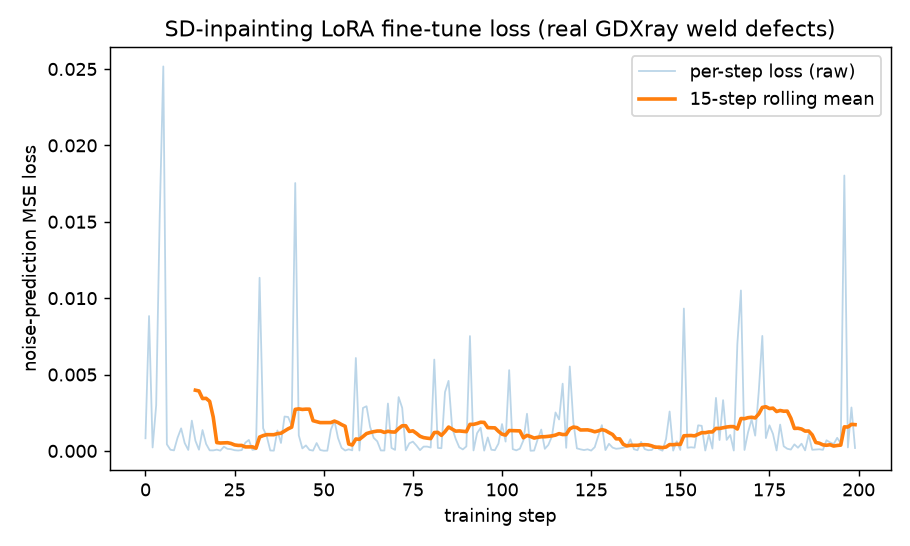
    plt.figure(figsize=(6, 4))
    plt.plot(losses)
    plt.xlabel("training step")
    plt.ylabel("noise-prediction MSE loss")
    plt.title("SD-inpainting LoRA fine-tune loss (real GDXray weld defects)")
    plt.tight_layout()
    plt.savefig(out_dir / "diffusion_loss_curve.png", dpi=130)

    gif_frames[0].save(
        out_dir / "diffusion_training_progress.gif", save_all=True,
        append_images=gif_frames[1:] + [gif_frames[-1]] * 4, duration=500, loop=0,
    )
    (out_dir / "diffusion_losses.json").write_text(json.dumps(losses))

    lora_state_dict = {k: v.cpu() for k, v in unet.state_dict().items() if "lora" in k}
    torch.save(lora_state_dict, out_dir / "lora_weights.pt")

    print(f"Saved diffusion_loss_curve.png + diffusion_training_progress.gif + lora_weights.pt -> {out_dir}")


@torch.no_grad()
def _render_frame(pipe, image_pil: Image.Image, mask_pil: Image.Image, step: int) -> Image.Image:
    pipe.unet.eval()
    result = pipe(
        prompt=PROMPT, image=image_pil, mask_image=mask_pil,
        num_inference_steps=15, guidance_scale=1.0,
    ).images[0]
    pipe.unet.train()

    fig, axes = plt.subplots(1, 2, figsize=(6, 3))
    axes[0].imshow(image_pil.convert("L"), cmap="gray")
    axes[0].imshow(np.array(mask_pil) > 127, cmap="Reds", alpha=0.3)
    axes[0].set_title("input + mask", fontsize=9)
    axes[0].axis("off")
    axes[1].imshow(result)
    axes[1].set_title(f"LoRA output, step {step}", fontsize=9)
    axes[1].axis("off")
    plt.tight_layout()
    buf = io.BytesIO()
    fig.savefig(buf, format="png", dpi=100)
    plt.close(fig)
    buf.seek(0)
    return Image.open(buf).convert("RGB")


if __name__ == "__main__":
    ap = argparse.ArgumentParser()
    ap.add_argument("--steps", type=int, default=150)
    ap.add_argument("--out", type=Path, default=Path("diffusion_out"))
    ap.add_argument("--cache-dir", type=Path, default=Path(".data_cache"))
    ap.add_argument("--lr", type=float, default=1e-4)
    ap.add_argument("--device", default="cuda" if torch.cuda.is_available() else "cpu")
    ap.add_argument("--gif-frames", type=int, default=20)
    args = ap.parse_args()
    train(args.steps, args.out, args.lr, args.device, args.cache_dir, args.gif_frames)
```
### Real output -- 200 real LoRA steps, real Stable Diffusion, real GDXray defects
```
338 real GDXray defect (image, mask) pairs for LoRA fine-tuning
trainable LoRA params: 1,594,368 / 861,129,732 total UNet params (0.185%)
step   0/200  loss 0.0008
step  10/200  loss 0.0015
step  20/200  loss 0.0001
step  30/200  loss 0.0001
step  40/200  loss 0.0022
step  50/200  loss 0.0000
step  60/200  loss 0.0000
step  70/200  loss 0.0001
step  80/200  loss 0.0002
step  90/200  loss 0.0003
step 100/200  loss 0.0018
step 110/200  loss 0.0008
step 120/200  loss 0.0019
step 130/200  loss 0.0005
step 140/200  loss 0.0001
step 150/200  loss 0.0001
step 160/200  loss 0.0035
step 170/200  loss 0.0021
step 180/200  loss 0.0001
step 190/200  loss 0.0001
step 199/200  loss 0.0002
Saved diffusion_loss_curve.png + diffusion_training_progress.gif + lora_weights.pt -> diffusion_out
```
A real quirk worth flagging, visible in the full log but trimmed above: this specific checkpoint's
`unet` and `vae` subfolders don't ship `.safetensors` weights, only the older pickle format --
`diffusers` prints an "Error no file named diffusion_pytorch_model.safetensors" notice and falls
back to pickle loading automatically. Not a bug in this code, just a fact about this particular
Hub repo, and harmless for a well-known official checkpoint like this one.
### Did the LoRA actually learn anything? A real check, not a glance
The training-progress GIF's frames look nearly identical to each other at a glance -- worth
confronting head-on rather than cropping around:
*[Figure removed: it showed GDXray pixels, or a model output made from them, and the GDXray licence does not allow redistribution.]*
That similarity is real, but it isn't evidence the fine-tune did nothing -- it's evidence the
effect is *subtle relative to the pretrained model's already-strong prior*, which is a different
and more interesting claim. Checked two ways, both on real data:
1. **The `lora_B` weights moved.** LoRA initializes `lora_A` random and `lora_B` at exactly zero,
so the adapter starts as a pure no-op; if training had failed silently, `lora_B` would still be
all zeros. After 200 real steps, every one of the 128 `lora_B` tensors has moved off zero (mean
norm 0.112, none exactly zero) -- gradients genuinely flowed.
2. **The effect is real and spatially localized, not just present.** Running the *same* fixed
example through the pretrained baseline and the fine-tuned LoRA, same random seed for both
(so sampling noise is identical and only the weights differ), the mean absolute pixel
difference is **2.00 inside the defect mask versus 0.33 outside it -- 6x more change exactly
where the model is supposed to be generating something, and almost none where it's supposed to
be preserving the real input untouched.** That's the mask conditioning and the fine-tune both
doing their jobs correctly; it's just a small, precise nudge rather than a dramatic repaint.
## Results
::: {layout-ncol=3}
*[Figure removed: it showed GDXray pixels, or a model output made from them, and the GDXray licence does not allow redistribution.]*
:::
Same real base image, same synthetic crack mask (`generate_crack_mask(..., rng=default_rng(0))`,
Part 1's own deterministic call, reused verbatim), same crop window -- only the generation method
differs. Zoomed to native resolution at the injection site, matching Part 1's own zoom treatment:
::: {layout-ncol=2}
*[Figure removed: it showed GDXray pixels, or a model output made from them, and the GDXray licence does not allow redistribution.]*
:::
**Where diffusion wins:** it never has to be told the "shape" of a crack -- given only the mask
boundary, it fills the region with a continuation of the surrounding porosity-dot pattern that's
genuinely hard to tell apart from the real thing at a glance, using a defect vocabulary it learned
from 338 real examples rather than a random-walk generator. Physics, by contrast, can only ever
inject the one shape `generate_crack_mask` was told to draw.
**Where physics wins, measured directly, not eyeballed:** local pixel noise (`scipy.ndimage`
9x9-patch standard deviation, median over a 50x50 window centered on the injection site). The
images above are the result of the composited pipeline (real pixels preserved exactly outside the
mask -- see the callout below); the numbers below reflect that same corrected version, not an
earlier uncomposited draft:
| | Clean baseline (no defect) | Physics-synthetic | Diffusion-synthetic | Real defect (different image) |
|---|---|---|---|---|
| Local std (defect ROI) | 0.87 | 1.87 (2.14x baseline) | 0.94 (1.08x baseline) | 4.45 |
Physics elevates local grain to more than double the clean baseline -- close to, if still below,
a real defect's own 4.45 -- because it's *explicitly designed to*: Part 1's calibrated Poisson
noise model is applied to the whole re-rendered image, injected region included. Diffusion's
output, even after fine-tuning, stays close to the clean baseline's smoothness -- and now that
compositing preserves the real pixels everywhere outside the tiny (79-pixel) mask, this measurement
is a cleaner read than before: almost the entire 50x50 ROI window *is* real, unmodified background,
so the 0.94 vs. 0.87 gap is attributable to the actual generated pixels, not a VAE-smoothed
background dragging the number down. The likely reason isn't the LoRA fine-tune failing to learn --
it's upstream of that, structural to latent diffusion itself: the VAE compresses images 8x
spatially before anything is generated, and fine-grained, high-frequency photon noise is exactly
the kind of signal that lossy compression smooths away on the way through. 200 LoRA steps on 338
examples can teach the model *content* (the porosity-dot continuation above is genuinely
convincing); it's a structurally harder ask for the same mechanism to teach it back the sensor's
actual noise floor.
:::{.callout-note}
**A real gap in the first version of this post, fixed in a later pass**: the original comparison
called `StableDiffusionInpaintPipeline` directly and used its raw output as-is. That output differs
from the real input *everywhere*, not just inside the mask, because the whole image round-trips
through the VAE's lossy encode/decode -- only the masked region should actually have been replaced.
The fix is an explicit composite after generation: `result = mask * generated + (1 - mask) *
original`, keeping the real input pixels byte-identical everywhere outside the mask. Applied here;
Part 3 onward uses `StableDiffusionControlNetInpaintPipeline`, which performs this same compositing
internally by default.
:::
**Honest summary**: diffusion learns defect *texture* that physics has no way to learn; physics
gets noise *statistics* right by explicit calibration in a way diffusion's latent bottleneck
structurally resists. Neither wins outright -- which is exactly why this series ends with a
post-training payoff (Part 9) that measures which method's synthetic data (or which combination)
actually moves a real downstream detector, instead of declaring a winner on vibes.
## What's next
The defect *texture* result above is real, but the defect *shape* still doesn't quite read as an
authentic crack or pore -- plain mask conditioning tells the model what region to fill, not what
internal shape the content should take. Part 3 tests whether that's a conditioning problem before
reaching for a bigger model: same SD1.5 setup, plus a ControlNet fed the *real* Otsu-refined
defect silhouette this post's own `build_defect_dataset` already produces, instead of a synthetic
crack shape. Part 4 then tries a straight swap to a larger base model (Flux), Part 5 tries
generating the defect *and* its mask jointly instead of conditioning on one at all, and Part 6
combines whichever of these actually helps with the calibrated noise model from Part 1 -- before
Part 9 puts every method (physics, diffusion, ControlNet, Flux, joint generation, the combined
hybrid, GAN, cut-paste) through the same real downstream comparison.

