This post is part of the SpatialClaw for Inspection series. It builds on Part 1, the deep dive. Everything here is a plan. Nothing in this post has been built or measured yet, and I say so wherever a sentence could be mistaken for a result.
Part 1 ended with a claim: half of SpatialClaw is irrelevant to image inspection, and the other half is small enough to rebuild. This post makes that claim concrete. It is the document I would want before writing any code: what changes, why, what could go wrong, and the experiment that decides whether the whole thing was a good idea.
0.1 The use case, in one paragraph
Inspection systems do not ask “which object is to the left of the table”. They ask: how big is this defect, how many are there, where are they relative to this feature, and does that break the spec? The input is one image (sometimes a handful of related crops), the scale is known from calibration, and the answer must be a verdict someone is accountable for. That is a measurement-and-decide problem. It is exactly the shape where code-as-action should help, because the measurement is arithmetic over masks.
0.2 Keep, swap, drop
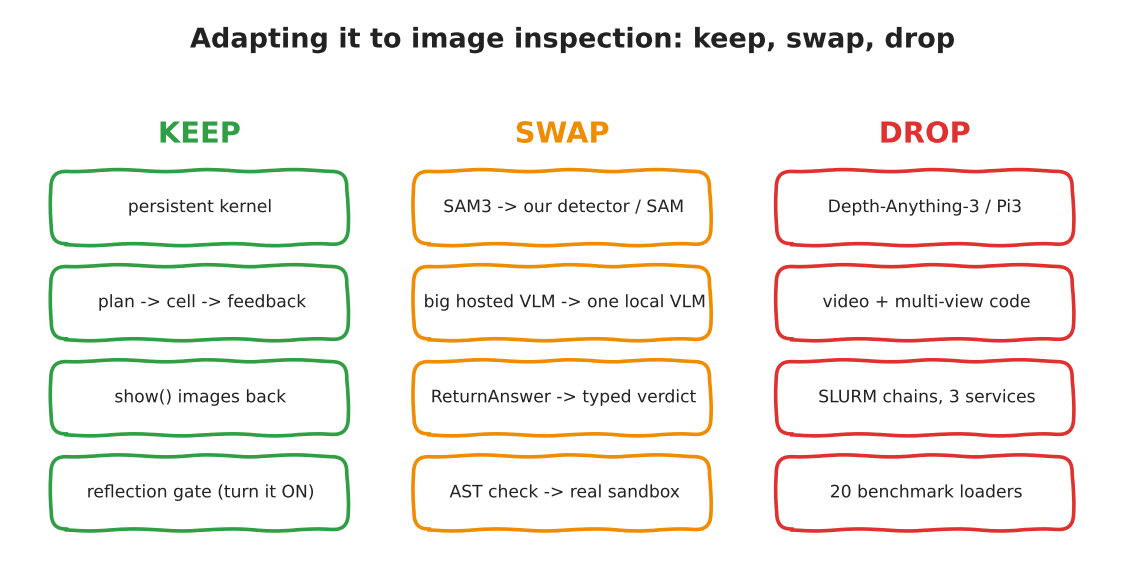
0.2.1 Keep
- The persistent kernel. This is the idea. Variables survive, a failed cell costs one cell.
- Plan, cell, feedback. Same loop shape. Part 1 showed it fits in a short graph.
show(). Inspection is visual. The model must see the crop it just measured.- The reflection gate, turned on. It is off by default upstream. For inspection I want something like it, but see below: I want the final decision gated by deterministic code, not by the same kind of model that made the guess.
0.2.2 Swap
| Upstream | Inspection version | Why |
|---|---|---|
| SAM3 as the one perception tool | Our own detector and SAM-family segmenter, behind the same tools.* style API |
We already have a void detector and a labelled synthetic dataset; the model should call what we trust. |
| 26B-397B hosted-scale backbones | One local VLM, chosen in Part 3 by measurement | Data stays on the machine, and cost is fixed. Model choice is an experiment, not a decision made here. |
ReturnAnswer("B") (free-form str/int/float) |
A typed verdict: PASS/FAIL/REVIEW plus measurements plus evidence image ids |
A shop floor cannot act on “B”. Upstream’s ReturnAnswer accepts only str, int or float (return_answer.py). |
| AST filter as “security” | A real sandbox (separate process, no network, resource limits, timeout) | Part 1 showed the filter passes indirect constructs. Defence in depth, not a filter. |
Metadata (fps, duration) |
Calibration: microns per pixel, image id, optional part/recipe id |
Without scale there are no physical units, and spec limits are physical. |
0.2.3 Drop
- Depth-Anything-3, Pi3, MapAnything. X-ray, optical and SEM inspection images are not scenes with perspective. The 3D tools have nothing to reconstruct.
- Video and multi-view logic, the temporal metadata, the per-video kernels.
- SLURM chains and the three-service runtime. One machine, one process pool.
- The 20 benchmark loaders. We will have one evaluation, on our own data.
0.3 Three design changes that matter more than the rest
0.3.1 1. The fallback must never guess PASS
Upstream’s force_terminate (router.py:58) runs when steps, failures or tool calls run out, and returns a best-guess answer from a chain-of-thought VLM call, or a regex over the chat. For a benchmark, a guess beats a blank. For inspection, a guess that says PASS is a defect shipped. My rule for the build: out of budget means REVIEW, always, with the partial evidence attached. This is a one-line behavioural change, and it is the most important line in the project.
0.3.2 2. The spec lives in code, not in the model’s head
The model measures. A deterministic rule function decides. If the spec says “total void area must stay under X% of the pad”, the agent produces void_ratio and a mask, and a plain function (ordinary tested Python, not model-written) compares it to the threshold. That keeps the part that must be auditable out of the part that is stochastic. (It echoes the plain-rule control I scored against the agents in Part 5 of the zero-to-advanced series, though there the rule filtered candidates; here it would own the final verdict.)
0.3.3 3. Prefer fewer tools that return numbers
Upstream’s Table 4 reports that performance degradation is “minimal” when the predefined utility functions are removed and replaced with on-the-fly NumPy. That suggests a thin tool surface works: the model can already do the geometry. So the inspection API stays small: segment, measure, crop, enhance, overlay, count. Everything else is NumPy and SciPy that the model writes. The risk I will watch for is the paper’s biggest failure bucket, geometric computation error (21% of their 1,000 failures); that is why measurements get verified against known synthetic ground truth.
0.4 Licensing: what the plan assumes
SpatialClaw’s code is non-commercial research only, and derivatives inherit that limit, so nothing from it gets copied. I write my own loop, kernel wrapper and prompts from the paper’s description. I have read the upstream source, so I will not call my version “clean-room”; each post says which ideas come from the paper. Not legal advice: have the licences reviewed before any work use.
0.5 How I will know it was worth it
The idea that justifies everything is one experiment. Same synthetic void dataset (exact ground truth, which I generate myself, so I can publish everything), same images, three systems:
| System | What it is |
|---|---|
| A. Detector alone | The plain baseline from the zero-to-advanced series |
| B. Tool-call agent | The agent I already built there, structured tools, a graph |
| C. Code-kernel agent | The new one, same perception tools, code as the interface |
Measured per image: verdict accuracy, void-area error against ground truth, false-PASS count (the number that matters most), steps, tokens and seconds. Failures classified with the paper’s own categories (geometric error, tool selection, hallucination, recovery failure) so we can compare kinds of mistakes, not only counts.
Pre-registered expectation, written before running anything: C beats B on questions that need chained measurement (area ratios, distances between features, counts filtered by size) and ties or loses on pure recognition, because the paper’s own single-image table shows tools hurting on BLINK and the tool-call agent winning on Omni3D. If C does not beat B on measurement tasks, the series says so and stops being a recommendation.
0.6 The roadmap
| Part | What gets built | Status |
|---|---|---|
| 1 | Deep dive of the paper and code | Published in this series |
| 2 | This plan | You are here |
| 3 | A minimal kernel loop, my own code, local model | Planned |
| 4 | The inspection tool API and show() |
Planned |
| 5 | A real sandbox, and trying to break it | Planned |
| 6 | The A/B/C experiment above | Planned |
| 7 | Typed verdicts, the rule layer, audit log, human-review path | Planned |
| 8 | Production patterns on real inspection tasks | Planned |
0.7 Risks I already see
- Latency. Thinking-enabled models plus up to 30 steps is slow. The paper reports accuracy, not per-sample time in the text I read. I will measure it and report it, because a line cannot wait a minute per image.
- Non-determinism. Same image, two runs, two paths. The rule layer and a fixed seed for temperature help, but I will measure run-to-run agreement instead of assuming it.
- Code the model writes is code that runs. Part 5 exists because of this.
- Confident wrong measurements. A plausible mask with a wrong threshold gives a precise wrong number. Overlay-and-look (
show()) plus ground-truth checks are the defence; the experiment will say how well it works.
0.8 Where this goes next
Part 3 is the first code: the smallest loop that can write a cell, run it in a persistent kernel and read the result back. Before it ships, it must pass the same rule as every paper post here: run one real step, show the real output, label every stand-in.
Reuse
Citation
@online{goni2026,
  author = {Goni, Hasan},
  title = {SpatialClaw for {Inspection,} {Part} 2: {The} {Adaptation}
    {Plan}},
  date = {2026-10-20},
  langid = {en}
}