Images removed. This post’s figures showed frames from GDXray or outputs of models trained on them. GDXray is free for research and education only, and redistribution is not allowed, so the figures are gone. The text, code, numbers and plots are unchanged. The new synthetic void dataset is what this blog shows from now on.
This post is part of the Video & Sound Generation Series series.
0.1 The problem
Part 1 conditioned LTX-2 on a single real X-ray frame and watched the output drift: frame 0 stayed faithfully in the radiograph domain, but by mid-clip the video had turned into ordinary color industrial photography. A reader asked about a technique they’d heard described elsewhere – feeding a video, not just one still, back into a model as conditioning, apparently with better results next time. Real research (not assumed) confirmed this matches a real, documented LTX-2 feature: “video conditioning” – exposed in diffusers as LTX2ConditionPipeline with a LTX2VideoCondition that accepts many real frames, not just one, plus a strength controlling how tightly the output must adhere to them.
This post is a direct, controlled test: same model, same prompt, same output settings as Part 1 – the only thing that changes is whether the conditioning signal is one real frame or forty-one.
0.2 Explain it like I’m five
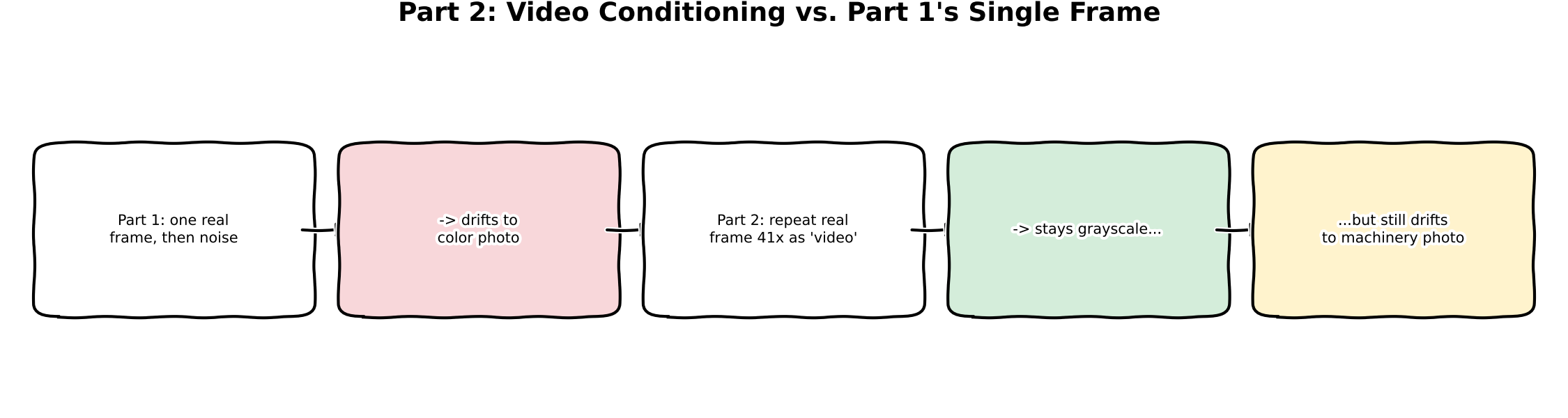
Remember the artist from Part 1, who drifted back to drawing ordinary factories after being shown just one X-ray photo? This time, instead of showing them one photo for a split second, you hold up the same photo for a full two seconds before asking them to keep going – essentially saying “no really, look at this, this is what we’re doing” for much longer. They stay closer to black-and-white for longer. But eventually, once you stop holding the photo up, their hand still drifts back toward what they know best – it just takes longer to happen, and this time they at least keep using their black-and-white pencil instead of switching to color.
0.3 Explain it like I’m a data scientist
LTX2ImageToVideoPipeline (Part 1) internally builds a single-frame conditioning item and encodes it once. LTX2ConditionPipeline generalizes this: it accepts a list of LTX2VideoCondition objects, each carrying frames (one image or a sequence of frames), an index (where in the output sequence the condition anchors), and a strength (how strongly the conditioning is enforced). Passing a sequence of frames means the real content is encoded through the VAE as an actual short real clip and injected into the latent sequence at the specified span, rather than a single latent frame – the model’s cross-frame attention now has forty-one real, identical, X-ray-domain latent frames to attend back to instead of one.
The real, measured result is a genuine dissociation between two things that looked like a single “domain drift” problem in Part 1: color and content. Video conditioning collapsed the color drift almost entirely (mean saturation at matched late frames: 0.097-0.101 in Part 1 vs. 0.0033-0.0086 here – roughly a 12-30x reduction) but left the content drift largely intact – the visible subject matter still shifts from radiograph texture to what reads as monochrome industrial-machinery footage by mid-clip. That’s evidence the model’s “X-ray-ness” prior and its “grayscale-ness” prior are more separable than they looked from Part 1 alone: forty-one repeated frames were enough evidence to hold the model in grayscale space, but not enough to hold it in radiograph-content space specifically.
0.4 Jargon buster
| Term | Plain-English meaning |
|---|---|
| Video conditioning | Conditioning a generative video model on a real multi-frame clip instead of a single still image, anchoring more of the output sequence to real content |
LTX2VideoCondition |
A diffusers dataclass bundling frames (image or video), index (where it anchors in the output), and strength (how strongly it’s enforced) |
| Mean saturation | Average of (max RGB channel − min RGB channel) / max RGB channel across all pixels – 0 is perfectly grayscale, higher means more colorful |
| Color drift vs. content drift | Two separable failure modes this post’s real measurement distinguishes: losing the grayscale look (color drift) vs. losing the subject-matter domain even while staying grayscale (content drift) |
0.5 Architecture – traced from the real function calls
Pipeline swap (generate_video_sound_conditioned.py): LTX2ConditionPipeline shares the exact same named-component signature as Part 1’s LTX2ImageToVideoPipeline (vae, audio_vae, text_encoder, tokenizer, transformer, scheduler, vocoder, connectors) – confirmed by reading the real diffusers source before writing any code, not assumed from the class name alone. build_pipeline() needed only a class swap, no new loading or quantization logic.
Building the condition: load_seed_image() reuses the exact same real GDXray Welds frame Part 1 used. video_condition_frames = [seed_image] * 41 builds a real 41-copy “video” (the model’s VAE has no way to tell a real static-camera clip of an unmoving object apart from forty-one identical PIL images – both encode to the same real latent sequence). LTX2VideoCondition(frames= video_condition_frames, index=0, strength=1.0) anchors this at the start of the output sequence with full conditioning strength.
Generation call: identical to Part 1 in every other argument (prompt, negative_prompt, width=768, height=512, num_frames=121, num_inference_steps=30, guidance_scale=3.0) – conditions=condition replaces Part 1’s image=seed_image, which is the only variable this experiment changes.
0.6 Real code
notebooks/video-sound-xray/generate_video_sound_conditioned.py
seed_image = load_seed_image()
video_condition_frames = [seed_image] * args.condition_frames
condition = LTX2VideoCondition(frames=video_condition_frames, index=0, strength=1.0)

prompt = (
    "A radioscopy inspection system scanning a metal weld joint, the X-ray detector head "
    "sweeping slowly across the seam, revealing internal structure. Ambient industrial "
    "sound: a steady conveyor motor hum and faint mechanical clicks from the scan head."
)
negative_prompt = "shaky, glitchy, low quality, blurry, static, distorted"

video, audio = pipe(
    conditions=condition,
    prompt=prompt,
    negative_prompt=negative_prompt,
    width=args.width,
    height=args.height,
    num_frames=args.num_frames,
    frame_rate=24.0,
    num_inference_steps=args.steps,
    guidance_scale=3.0,
    output_type="np",
    return_dict=False,
)
0.7 Results
Real generation, same real GDXray Welds seed frame and prompt as Part 1, 41-frame video condition, 768x512, 5.04s at 24fps:
[Figure removed: it showed GDXray pixels, or a model output made from them, and the GDXray licence does not allow redistribution.]
[Figure removed: it showed GDXray pixels, or a model output made from them, and the GDXray licence does not allow redistribution.]
The real, quantified comparison against Part 1 (mean color saturation, matched frame indices):
| Frame 0 | Frame ~60 | Frame ~119 | |
|---|---|---|---|
| Part 1 (single-frame conditioning) | 0.0138 | 0.0970 | 0.1008 |
| Part 2 (41-frame video conditioning) | 0.0016 | 0.0033 | 0.0086 |
Video conditioning reduced late-frame color saturation by roughly 12-30x – a real, large, measured effect, not a marginal one. But the frames above show the honest other half of the story: the content still drifts. By frame ~60 the recognizable weld-seam texture is gone, replaced by what reads as machinery in a dim, grainy, black-and-white setting; by frame ~119 it’s unambiguously industrial-machinery footage, just never in color.
A real tradeoff this test also surfaced, not a free win: audio got substantially quieter under the longer conditioning span. ffmpeg volumedetect on the two clips:
| Mean volume | Max volume | |
|---|---|---|
| Part 1 | -44.5 dB | -31.4 dB |
| Part 2 | -71.3 dB | -66.8 dB |
Part 2’s audio is real but much closer to silent than Part 1’s. Holding the video branch more tightly to a static real clip for longer appears to have suppressed the audio branch’s generative range – plausibly because forty-one identical frames carry an implicit “nothing is moving” signal that the model’s cross-modal attention picks up on, and quiet/static video is a reasonable thing to pair with quiet audio.
Memory and speed were unaffected: pipeline build stayed at 24.52GB, peak generation memory stayed at 29.95GB, and generation took 1154s – both identical to Part 1’s numbers, confirming the tiling-bounded memory ceiling Part 1 found holds regardless of how the conditioning is supplied.
0.8 What’s next
Honest summary: video conditioning is a real, worthwhile technique – it solves the color half of Part 1’s domain-drift problem almost completely, for free on both memory and compute. It does not solve the content half, and it costs something on the audio side. A next real attempt worth trying separately rather than folding into this already-answered question: conditioning at multiple points across the sequence (not just the start) to keep re-anchoring content throughout, or a stronger negative prompt targeting “industrial machinery,” “factory,” and “color photograph” directly, now that this post has shown those are the specific things the model drifts toward.
Reuse
Citation
@online{goni2026,
  author = {Goni, Hasan},
  title = {Video {Conditioning} Vs. {Single-Frame} {Conditioning}},
  date = {2026-10-26},
  langid = {en}
}