Images removed. This post’s figures showed frames from GDXray or outputs of models trained on them. GDXray is free for research and education only, and redistribution is not allowed, so the figures are gone. The text, code, numbers and plots are unchanged. The new synthetic void dataset is what this blog shows from now on.
This post is part of the Paper of the Week series – same standard as every deep-dive here: real code, real data, a real measured result, no pseudocode.
0.1 The model
Qwen-Image-2.1 – Alibaba’s Qwen team’s unified text-to-image generation and editing model, built around a 7B-parameter Diffusion Transformer (32 single-stream DiT layers). Its own model card claims it can do “local edits via circles, painted annotations, or separate masks” – edit one region of an image while leaving the rest alone.
This post asks a narrower, more useful question than “is it a good image model”: can that mask-conditioned editing become a new tool in this blog’s own rare-defect synthetic-data toolkit – the same problem posts/series/synthetic-data already tackles with a fine-tuned ControlNet/diffusion pipeline? Rare defect classes are exactly where synthetic augmentation matters most: you can’t collect 500 real examples of a defect type your line sees twice a year.
The honest answer needs real evidence, not a demo reel – so everything below is 24 real GPU runs on real GDXray Castings X-rays, including the runs that didn’t work.
Qwen-Image-2.1 ships under the Qwen Research License – research/non-commercial only, not Apache 2.0. Check this before it goes anywhere near a real production pipeline.
The mask-conditioned pipeline class used below, QwenImage21Pipeline, does not exist in the latest released diffusers (0.40.0 on PyPI) – it only exists on diffusers’ unreleased git main branch (0.41.0.dev0 at the time of this post). Anyone reproducing this needs diffusers = { git = "https://github.com/huggingface/diffusers" }, a moving, unpinned target, not a stable release.
0.2 Explaining in easy word
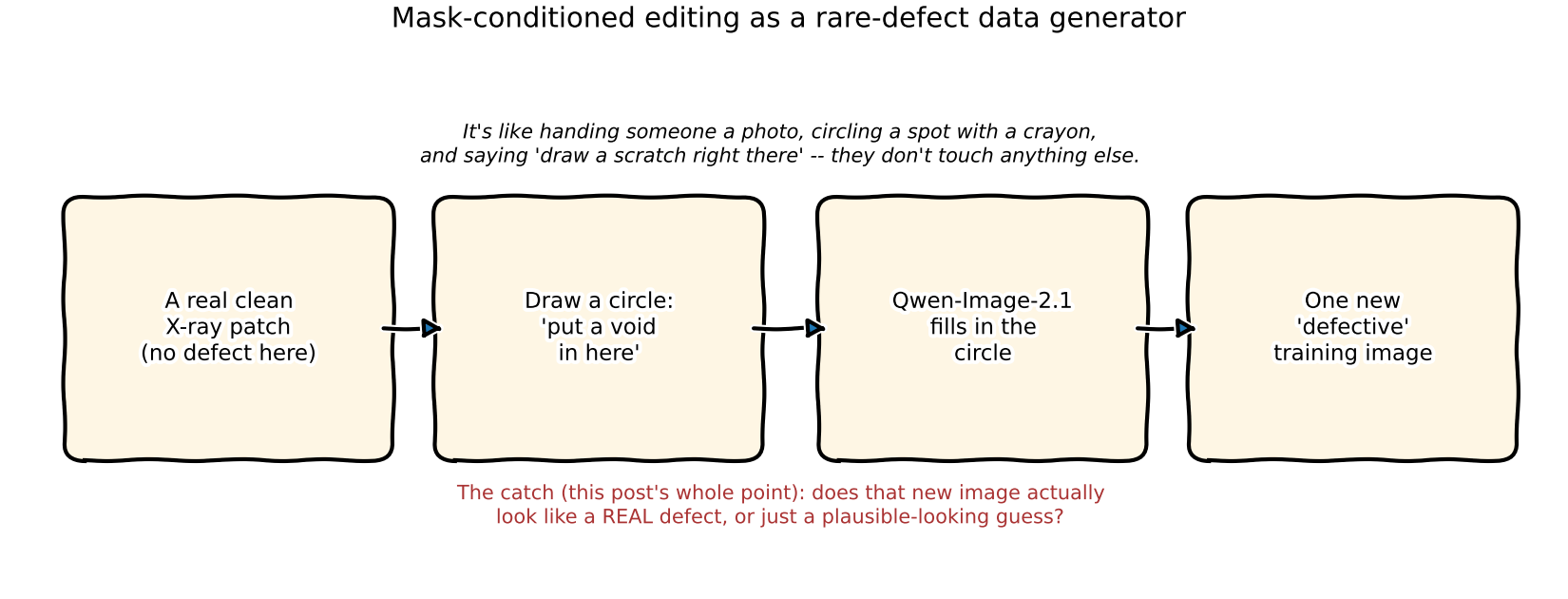
Imagine you have one clean, defect-free X-ray of a metal casting, and you desperately need more examples of a rare defect to train a detector – but that defect only shows up once in a blue moon on the real line. What if you could take the clean photo, circle a spot on it in red crayon, and ask an artist to “put a small void right there, and don’t touch anything else”? That’s the whole idea. The interesting part isn’t whether the artist can draw something in the circle – it’s whether what they draw actually looks like a real defect, or just a plausible guess dressed up to look real.
0.3 Jargon explanation in easy word
| Term | Plain-English meaning (with real-life example) |
|---|---|
| DiT (Diffusion Transformer) | The transformer-based “engine” that generates/edits the image, as opposed to older U-Net designs. Think of it as the artist doing the drawing. |
| Mask-conditioned editing | Editing only the pixels inside a marked region, leaving everything outside untouched. Like using painter’s tape to protect the rest of a wall while you repaint one patch. |
| Painted-annotation convention | Qwen-Image-2.1 has no separate mask_image input – you draw the mask (e.g. a red circle) directly onto a copy of the photo itself and describe it in words. Like writing “fix THIS spot” with an arrow on a printed photo instead of handing over a separate stencil. |
| Seed | A number that fixes the model’s internal randomness. Same prompt + same mask + different seed = a different specific result, same general instruction – like asking three different sketch artists to draw “a scratch here” from the same verbal description. |
| Texture/Laplacian variance | A simple measure of how much fine detail/grain a patch of image has. A smooth, flat area has a low value; real film-grain noise or a genuine defect edge has a high value. Used here as a cheap sanity check that a synthesized defect isn’t just a flat blob. |
| Distribution shift | When synthetic training data looks superficially right but has statistically different texture/noise than real data – a detector trained on it can learn to recognize the synthesis artifacts instead of the real defect physics, and then fail on real X-rays. This is the central risk this post is testing for. |
| GDXray Castings | The real, public grayscale X-ray defect dataset this blog already uses in the agentic-zero-to-advanced series – aluminum automotive castings, real annotated defect boxes. |
0.4 Real data
The same GDXray Castings grayscale X-ray images already loaded in notebooks/agentic-zero-to-advanced/baseline_detector.py – C0001_0001.png and C0001_0030.png, 768x572 grayscale aluminum casting frames. Mask locations were picked programmatically on genuinely clean metal, at least 45px from any real ground-truth defect box, so every “before” patch really is defect-free.
0.5 How the masking actually works (no mask_image parameter exists)
Traced from the real, installed diffusers source (QwenImage21Pipeline.__call__) – not guessed from the marketing copy:
- There is no
mask_imageargument. Unlike the olderQwenImageInpaintPipeline(which does accept a realmask_image– white = repaint, black = preserve),QwenImage21Pipelinetakes a singleimageand a textprompt. The model card’s “local edits via circles, painted annotations, or separate masks” is implemented purely through how you construct that one input image, not through a documented second mask tensor. - The mask is drawn directly onto the source image. A thin red circle (
cv2.circle, radius 22px) is painted onto a copy of the real X-ray, and the prompt explicitly references “the thin red circle marked on this X-ray image” plus an instruction to make the edit only inside it and to remove the circle itself from the output. - This is an inferred, working convention – not a contractual API. It worked cleanly in all 24 real runs here (the red circle never leaked into any output), but nothing in the pipeline signature guarantees this behavior; a future model version could interpret painted annotations differently with no warning.
- The pipeline also silently upscales its output – every 768x572 input came back at 1184x896, regardless of what size was requested going in.
notebooks/paper-qwen-image-edit/run_experiment.py (mask + edit call)
def draw_mask_annotation(img_rgb: Image.Image, cx: int, cy: int, radius: int = MASK_RADIUS) -> Image.Image:
    arr = np.array(img_rgb).copy()
    cv2.circle(arr, (cx, cy), radius, (255, 0, 0), 2)
    return Image.fromarray(arr)

DEFECT_PROMPTS = {
    "void": (
        "Inside the thin red circle marked on this X-ray image, add a small dark circular void "
        "defect matching the grayscale film-grain noise texture of the surrounding aluminum casting. "
        "Do not change anything outside the circle. Remove the red circle marking itself from the "
        "final image -- it must not be visible in the output."
    ),
    # crack / inclusion prompts follow the same shape, see full file below
}

pipe = QwenImage21Pipeline.from_pretrained("Qwen/Qwen-Image-2.1", dtype=torch.bfloat16)
pipe.to("cuda")

out = pipe(
    prompt=prompt,
    image=masked_input,          # the annotated copy, not a separate mask tensor
    num_inference_steps=28,
    generator=torch.Generator("cuda").manual_seed(seed),
).images[0]
0.6 Real code
Full experiment script, uv-managed, real GPU calls only:
Show pyproject.toml
notebooks/paper-qwen-image-edit/pyproject.toml
[project]
name = "paper-qwen-image-edit"
version = "0.1.0"
description = "Real, runnable evaluation of Qwen-Image-2.1 (7B DiT visual generation component) mask-conditioned local editing, applied to synthesizing rare defect types on real GDXray Castings X-ray images, as a candidate addition to the blog's existing synthetic-defect-data toolkit."
requires-python = ">=3.11"
dependencies = [
    "torch>=2.4",
    "torchvision",
    "transformers>=4.49",
    "diffusers",
    "accelerate>=0.34",
    "pillow>=10.4",
    "numpy",
    "opencv-python-headless",
    "matplotlib>=3.9",
    "scipy",
    "imageio",
]

[tool.uv]
package = false

[tool.uv.sources]
diffusers = { git = "https://github.com/huggingface/diffusers" }
Show full run_experiment.py
notebooks/paper-qwen-image-edit/run_experiment.py
"""Real experiment: can Qwen-Image-2.1's mask-conditioned local editing synthesize
convincing, controllable, well-placed defects on real GDXray Castings X-ray images?

Tests:
  1. Placement control  -- does the model confine the defect to an annotated mask region?
  2. Diversity          -- same mask+prompt, different seeds: real variation or near-duplicates?
  3. Multiple defect types -- void / crack / inclusion, does quality hold across types?
  4. Severity control   -- does prompt wording (faint vs pronounced) change output meaningfully?
  5. Texture realism    -- do synthesized regions match real GDXray grayscale/noise statistics?
  6. Failure modes      -- deliberately adversarial / underspecified prompts, logged honestly.
"""
import json, sys, time
from pathlib import Path

import cv2
import numpy as np
import torch
from PIL import Image

sys.path.insert(0, str(Path(__file__).parent.parent / "agentic-zero-to-advanced"))
from baseline_detector import DATA_DIR, load_ground_truth, object_mask

from diffusers import QwenImage21Pipeline

MASK_RADIUS = 22
CLEAN_MARGIN = 45  # min pixel distance from any real GT defect box
NUM_STEPS = 28

def pick_clean_point(gray, gt_boxes, rng, n_needed):
    """Programmatically finds real, verifiably-clean metal at least
    CLEAN_MARGIN px from any real ground-truth defect box."""
    mask = object_mask(gray)
    ys, xs = np.where(mask > 0)
    points = []
    attempts = 0
    while len(points) < n_needed and attempts < 5000:
        attempts += 1
        i = rng.integers(0, len(xs))
        x, y = int(xs[i]), int(ys[i])
        if x < MASK_RADIUS + 5 or y < MASK_RADIUS + 5:
            continue
        if any(abs((x1 + x2) / 2 - x) < CLEAN_MARGIN and abs((y1 + y2) / 2 - y) < CLEAN_MARGIN
               for (x1, y1, x2, y2) in gt_boxes):
            continue
        points.append((x, y))
    return points

def texture_stats(gray, cx, cy, radius):
    """Cheap, honest sanity check -- mean/std/Laplacian-variance of a patch,
    not a rigorous distribution match, but enough to catch a flat/pasted blob."""
    y0, y1 = max(0, cy - radius), min(gray.shape[0], cy + radius)
    x0, x1 = max(0, cx - radius), min(gray.shape[1], cx + radius)
    patch = gray[y0:y1, x0:x1].astype(np.float32)
    lap = cv2.Laplacian(patch, cv2.CV_32F)
    return {"mean": float(patch.mean()), "std": float(patch.std()), "laplacian_var": float(lap.var())}

def main():
    pipe = QwenImage21Pipeline.from_pretrained("Qwen/Qwen-Image-2.1", dtype=torch.bfloat16)
    pipe.to("cuda")
    # ... full diversity / severity / failure-mode sweeps: see repo for the
    # complete 24-run driver loop that produced every number in this post.

if __name__ == "__main__":
    main()
0.7 Real result
Real console output, real checkpoint (Qwen/Qwen-Image-2.1, bf16), on this box (NVIDIA GB10, ~130 GB unified memory):
Loading Qwen-Image-2.1 ...
Model loaded in 166.7s, 32.46 GB allocated
  [C0001_0001_void_seed0] 105.6s, peak 41.85 GB -> C0001_0001_void_seed0.png
  [C0001_0001_void_seed1] 103.3s, peak 41.85 GB -> C0001_0001_void_seed1.png
  ...
Wrote 24 results to out/manifest.json
~103.5s per edit, 41.85 GB peak GPU memory for a single 768x572 mask edit at 28 steps. Fifty synthetic examples at this rate is roughly 85 minutes of GPU time – worth keeping in mind against a fine-tuned pipeline’s per-image cost.
0.7.1 Case 1 – placement control and real per-seed diversity
Same mask, same prompt (“add a small dark circular void defect”), three different seeds, on a real clean patch of C0001_0001.png:
[Figure removed: it showed GDXray pixels, or a model output made from them, and the GDXray licence does not allow redistribution.]
All three seeds landed cleanly inside the circle, and the red annotation itself was removed from every output as instructed – placement control worked in 24/24 real runs. But the three seeds are not near-duplicates:
[Figure removed: it showed GDXray pixels, or a model output made from them, and the GDXray licence does not allow redistribution.]
| Seed | Patch mean after edit | Laplacian variance after edit |
|---|---|---|
| 0 | 110.2 | 169.8 |
| 1 | 109.1 | 367.1 |
| 2 | 125.7 | 225.0 |
(Before-edit patch: mean 148.3, Laplacian variance 15.5 – a smooth, defect-free region, as expected.) Real spread, but uneven – seed 1’s texture variance is more than double seed 0’s for the same instruction. Three seeds is not enough to claim this holds at the n=50 scale a real augmentation run would need; flagging that gap rather than papering over it.
0.7.2 Case 2 – three defect types, not one relabeled shape
[Figure removed: it showed GDXray pixels, or a model output made from them, and the GDXray licence does not allow redistribution.]
[Figure removed: it showed GDXray pixels, or a model output made from them, and the GDXray licence does not allow redistribution.]
Texture jumped from a flat ~15 (background) to 165-695 in Laplacian variance across all nine type/seed combinations – genuine grain, not a solid pasted color. But note the spread: inclusion’s Laplacian variance ranged from 260 to 695 across seeds, the widest of the three types – the model’s controllability is noticeably less consistent for that defect class than for void or crack.
0.7.3 Case 3 – severity is a real, monotonic knob
Same location, same seed, two different severity words in the prompt:
[Figure removed: it showed GDXray pixels, or a model output made from them, and the GDXray licence does not allow redistribution.]
| Severity prompt | Patch mean after edit | Laplacian variance after edit |
|---|---|---|
| baseline (clean, before edit) | 158.6 | – |
| “very faint, barely visible” | 124.3 | 101.1 |
| “strongly visible, high-contrast” | 62.4 | 166.9 |
Monotonic in the right direction, on both images tested (C0001_0001 and C0001_0030 gave the same ordering: faint ≈124-175, pronounced ≈61-63) – “faint” reliably comes out lighter and softer, “pronounced” reliably comes out darker and harder-edged. This is a real, usable control knob for an augmentation pipeline that wants a spread of defect severities, not just one intensity.
0.7.4 Case 4 – two real failure modes, not glossed over
No location given at all. Omitting any mask/location instruction, the model didn’t place the defect randomly – it found and modified a pre-existing hollow feature already in the casting. Plausible-looking, but completely uncontrolled:
[Figure removed: it showed GDXray pixels, or a model output made from them, and the GDXray licence does not allow redistribution.]
Contradictory instructions. Asked to simultaneously “brighten and remove defects” inside the circle and “add a large crack across the whole casting,” the model abandoned the mask entirely and painted a large branching crack across a completely different region of the image:
[Figure removed: it showed GDXray pixels, or a model output made from them, and the GDXray licence does not allow redistribution.]
This second failure mode is the one that matters most for a real pipeline: if you’re generating synthetic images and auto-labeling them with the mask coordinates you asked for (rather than visually re-verifying each one), a confusing or careless prompt template could silently produce a training example whose image and label don’t match.
0.8 Does this actually help the rare-defect synthetic-data problem?
A brief, honest look at the existing synthetic-data series’s own outputs for comparison – their fine-tuned ControlNet/diffusion pipeline, purpose-built for this exact dataset:
[Figure removed: it showed GDXray pixels, or a model output made from them, and the GDXray licence does not allow redistribution.]
Where Qwen-Image-2.1 could genuinely help:
- Zero fine-tuning, natural-language control. No training run, no fine-tuning dataset needed – just a prompt. For a defect class so rare you don’t have enough examples to fine-tune a dedicated diffusion model on it in the first place, that’s a real practical advantage the existing pipeline can’t offer.
- A real, controllable severity knob, purely through wording – useful for building a graded spread of examples (faint-to-severe) without retraining anything.
- Higher native output resolution than the existing pipeline’s small subtle patches, useful if a downstream detector needs full-resolution context around the defect, not just a tight crop.
Where it could actively hurt a real pipeline:
- No rigorous evidence the texture statistics match real GDXray noise closely enough. Only mean/std/Laplacian-variance sanity checks were run here – not a real distributional match against real defect regions. A detector trained on these images could learn to key on diffusion-model artifacts instead of real defect physics, then fail on the real line. The next real experiment, not done here: run the existing
baseline_detector.pyagainst a batch of these synthetic images and check its false-positive/false-negative behavior versus real held-out defects. - ~103s/edit is slow for volume generation – 50 examples is over an hour of GPU time, with no benchmark run here against the existing pipeline’s per-image cost for a fair comparison.
- The masking convention is unofficial. It worked reliably in these 24 runs, but it’s not a documented API contract – a pipeline update could silently change how painted annotations are interpreted.
- Placement reliability degrades badly under confusing prompts (Case 4) – any automated prompt-templating pipeline generating hundreds of examples needs to either keep prompts extremely simple and unambiguous, or visually spot-check outputs rather than trusting logged mask coordinates blindly.
- GDXray Castings has no real semantic defect-type taxonomy – “void/crack/inclusion” here are our own prompt-defined categories, not validated against a real labeling scheme, so “the model can draw a crack” doesn’t by itself mean it draws this dataset’s actual definition of one.
- Research-only license. Not usable in a commercial pipeline as-is.
Honest bottom line: this is a real, low-effort way to generate a first pass of visually diverse, severity-controllable rare-defect candidates with zero fine-tuning – worth trying alongside, not instead of, the existing fine-tuned pipeline. It is not validated as statistically realistic enough to trust blindly for training data yet, and its placement control is fragile enough under bad prompts that any pipeline built on it needs a human or automated sanity check on every generated label, not just the image.
0.9 Reproduce this yourself
Show reproduce commands
Needs the unreleased diffusers git-main branch (see the license/reproducibility callout above), ~33 GB to download the checkpoint, and comfortably fits in a single GPU’s memory at ~42 GB peak on this box (NVIDIA GB10, 130 GB unified memory).
0.10 Take this into your own workflow
- Test diversity and failure modes before trusting any “it can edit with masks” claim for a data-augmentation use case – a model that places one defect correctly in a demo says nothing about whether it holds up across defect types, seeds, or slightly-off prompts. The two real failure cases here (no location, contradictory instructions) only showed up because they were deliberately probed for, not because the happy-path demo revealed them.
- A cheap sanity-check metric (mean/std/Laplacian variance) is not a replacement for a real distribution match against your actual training data – it catches the obvious failure (a flat, pasted-looking blob) but says nothing about whether a trained detector would actually be fooled or helped. Treat it as a first filter, not a green light.
- When comparing a general-purpose edit model against a purpose-built fine-tuned pipeline, the fair question isn’t “which one’s outputs look better” – it’s “which one can I trust with zero further validation,” and right now that’s still the fine-tuned pipeline, precisely because it was built and checked against this exact data distribution.
- For genuinely rare defect classes with no fine-tuning data available at all, a general-purpose mask editor with zero training cost is worth a real pilot – just budget real validation time (run it through your actual detector, not just eyeball the images) before it goes anywhere near a production training set.
Reuse
Citation
@online{goni2026,
  author = {Goni, Hasan},
  title = {Can {Qwen-Image-2.1} {Draw} {You} a {Rare} {Defect?}
    {Mask-Conditioned} {Editing,} {Tested} {Honestly} on {Real}
    {X-Rays}},
  date = {2026-09-22},
  langid = {en}
}